Field notes
How Tailor-Made Touring Took Root in New Zealand
From a typed itinerary in a Christchurch booking office to today's bespoke routes, how tailor-made touring in New Zealand grew across five decades of change.
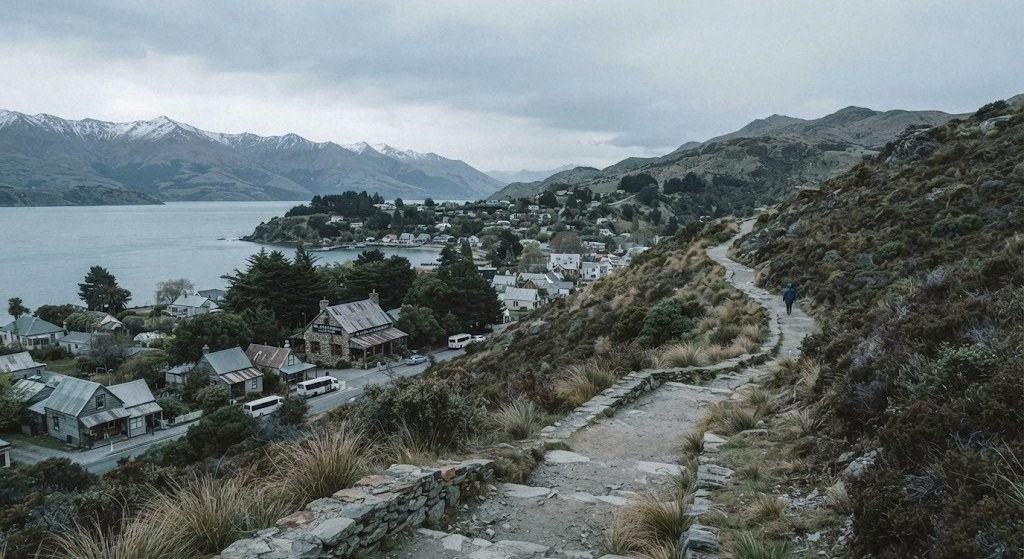
In 1968, in a converted booking office in Christchurch, a tour operator typed out a fourteen-day route on two sheets of paper and offered to change any line of it for a traveller who asked. That small offer, the willingness to redraw a route around one person's wishes rather than a printed timetable, is the seed of everything now called a tailor-made New Zealand journey. The typed sheet is long gone, but the idea it carried never left.
The coach decade: 1968 to 1980
When organised touring took hold in New Zealand in the late sixties, it was rigid by design. A coach held a fixed group, followed a fixed route, and the operator's skill lay in making the fixed route work. Vehicles were basic, hotels were whatever a small town could offer, and the traveller's only real choice was which departure to join. Yet even then, the best operators kept a pencil beside the itinerary, because the country's distances made one truth obvious: no two visitors wanted the same balance of mountains, cities and coast.
The independent wave: 1980 to 2000
Through the eighties and nineties, rental cars and backpacker networks pulled younger travellers away from coaches, and the industry responded in the only sensible way. Operators began selling flexibility instead of seats. A base itinerary now came with alternatives: swap a city night for a lodge stay, replace a morning drive with a cruise, extend a stop if the weather favoured it. The traveller who wanted a structure without a straitjacket finally had somewhere to buy one, and the customised tour stopped being a favour and became a product.
"We sold the same country twice, once as a timetable and once as a question. The question sold better."
- a route planner's note, touring company ledger, 1994
The online turn: 2000 to 2015
When bookings moved to screens, customisation accelerated. Travellers arrived knowing which vineyards, film sets and geothermal parks they wanted, and operators built tools to fold those wishes into a workable route with sane driving hours. This is the era that produced the modern custom tour as most people meet it: an expert-drafted skeleton, and a conversation that bends the skeleton around the traveller before anything is booked.
What a tailored journey looks like now
Today a bespoke New Zealand itinerary is assembled the way a good menu is. The structure still carries the classics, because some things are classics for reasons of geography, but every block of it can be traded. The craft lies in knowing which trades cost time you do not have.
- Fixed anchors that remain: arrival and departure cities, the interisland crossing, and realistic daily distances.
- What bends: activity choices, hotel grades, the share of driving versus cruising, and how long you linger in wine country.
The places that shaped this history are all still working. Auckland still opens most itineraries, Rotorua still anchors the geothermal heartland, Wellington still guards the ferry terminal to the South Island, and Queenstown still closes the loop beside Lake Wakatipu. The trades available in 1968 have multiplied, but the question the operator asks has not changed since that typed sheet in the Christchurch office.
The question worth asking
If you are considering a tailored journey, begin where this story ends: at the map on the wall of the first booking office, redrawn once more. Decide which single experience you would regret missing, whether that is Waiheke Island's vineyards or the jet boats on the Shotover, and let an operator build outward from it. A custom route is still, at heart, a timetable that agreed to become a question, and the first question worth answering is when you want to travel.
Written by the Fernhollow Journeys team. Routes are checked on the ground and pages are edited in place when something changes. Spotted an error? Tell us and we will fix it.
Next step
Let us plan the next one
A short brief is enough. We reply with questions, a route sketch and what it would cost before you commit to anything.